RESIDENTIAL CAPITAL GAINS TAX ADVICE

Capital Gains Tax on Residential Property

We provide practical Capital Gains Tax advice to help you understand your potential liability when selling or transferring residential property, including the reliefs and exemptions that may apply.

Whether you are selling a second home, buy-to-let property, holiday let, or a property that has been your main residence, our accountants can help you understand your potential tax position and reporting responsibilities.


Business Capital Gains Tax accountants and specialists

Whether you are selling a second home, buy-to-let property, holiday let or a property that has been your main residence, we can help you understand the relevant rules, reliefs, exemptions and reporting requirements.

CAPITAL GAINS TAX SPECIALISTS

Accountants & Specialists in Capital Gains Tax

Capital Gains Tax can be complex, particularly when selling or disposing of residential property that has increased in value. Understanding your potential liability before you sell can help you plan ahead and avoid unexpected tax costs.

At Care Accountancy, we provide specialist advice on Capital Gains Tax for residential property. We can help you understand how the rules apply to your circumstances and what you may need to consider before disposing of your property.

UNDERSTANDING RESIDENTIAL PROPERTY CGT

What Is Capital Gains Tax on Residential Property?

Capital Gains Tax (CGT) may apply when you sell or dispose of a residential property that has increased in value. The tax is generally based on the gain you make rather than the total amount received from the sale.

Your taxable gain can be affected by the property's purchase price, qualifying improvement costs, selling costs, capital losses, allowances and available reliefs. The rules can also vary depending on how the property has been used and owned.

Whether you are selling a second home, buy-to-let property or a property that has been both your main residence and a rental property, professional advice can help you understand your potential CGT liability and reporting responsibilities.

Assets that may be subject to CGT

  • Second homes
  • Buy-to-let properties
  • Rental prperties
  • Holiday lets
  • Investment properties
  • Properties used as both a main residence and rental property

Not sure if Capital Gains Tax applies to you?

Speak to our team about your circumstances and get professional guidance before you dispose of an asset.

"`html
RESIDENTIAL CAPITAL GAINS TAX GUIDANCE

Practical Residential CGT Guidance

Practical summaries to help you understand when Capital Gains Tax may apply to residential property, how your gain may be calculated, and which reliefs or exemptions could reduce your tax liability.

📄

When Does CGT Apply to Residential Property?

Understand when Capital Gains Tax can apply when selling, transferring or disposing of residential property.

Read More

Capital Gains Tax may apply when you dispose of a residential property that is not fully covered by Private Residence Relief.

This can include buy-to-let properties, second homes and other residential property that has not been your only main residence throughout the period of ownership.

CGT can also arise where your main home has been used for letting or business purposes, or where other circumstances mean that only part of the gain qualifies for relief.

The tax position depends on factors such as how the property was used, how long you owned it, the amount of the gain and which reliefs may be available.

It is therefore important to establish the potential CGT position before completing a property sale.

Care Accountancy can review your property history and help determine whether Capital Gains Tax may apply.

Learn more about our Capital Gains Tax services
£

Private Residence Relief

Understand how Private Residence Relief may reduce CGT when selling your main home.

Read More

Private Residence Relief can reduce or eliminate Capital Gains Tax when you sell a property that has been your main residence.

Where you have occupied a property as your main home for the relevant period, the qualifying period may benefit from Private Residence Relief.

The final nine months of ownership can generally qualify for relief, subject to the relevant conditions. A longer final period can apply in certain circumstances.

The position can become more complicated where you have rented out part or all of the property, used part of it for business, or had periods when it was not your main home.

Married couples and civil partners can generally only have one main residence for Private Residence Relief purposes at any one time.

Care Accountancy can review your ownership and occupation history to help establish how Private Residence Relief may apply.

Discuss your residential CGT position

CGT on Buy-to-Let & Second Homes

Find out how Capital Gains Tax can apply when selling an investment property or second home.

Read More

Selling a buy-to-let property or second home can result in a Capital Gains Tax liability if the property has increased in value since it was acquired.

Unlike a qualifying main residence, an investment property will not normally receive full Private Residence Relief.

The amount of CGT payable depends on the gain, allowable costs, available losses and reliefs, your taxable income and the applicable Capital Gains Tax rates.

If a property was previously your main residence and was later rented out, the calculation can be more complex because different periods of ownership may receive different tax treatment.

Accurate records of the purchase price, improvement costs, acquisition expenses and disposal costs can be important when calculating the taxable gain.

Care Accountancy can help calculate the potential gain and assess the reliefs that may be available.

Get advice on CGT for your property
%

Calculating Your Property Gain

Understand how the gain on a residential property is calculated and which costs may be allowable.

Read More

Your property gain is generally based on the difference between the disposal proceeds and the allowable cost of acquiring and disposing of the property.

Allowable costs can include the purchase price and certain costs associated with buying and selling the property.

Qualifying improvement expenditure may also be taken into account where it has enhanced the value of the property and meets the relevant conditions.

Where the property has been your main residence for only part of the ownership period, the gain may need to be apportioned to establish the amount potentially subject to CGT.

Capital losses and applicable reliefs may further reduce the taxable gain.

For 2026/27, individuals have an Annual Exempt Amount of £3,000. CGT is generally only payable on overall gains above this allowance after relevant deductions and reliefs.

Ask us to calculate your potential CGT

The 60-Day Reporting Rule

Understand when a residential property disposal must be reported and CGT paid to HMRC.

Read More

The 60-day reporting rule is particularly important when disposing of UK residential property.

Where Capital Gains Tax is due on a UK residential property disposal, the disposal generally needs to be reported to HMRC and the tax paid within 60 days of completion.

The deadline is based on the completion date of the property transaction, so it is important to act promptly after completion.

This reporting requirement can apply even where the disposal will ultimately also need to be included on a Self Assessment tax return.

Failure to report and pay on time can result in penalties and interest, depending on the circumstances.

Care Accountancy can help calculate the gain, prepare the necessary information and assist with your reporting obligations.

Get help with the 60-day CGT deadline
!

Reporting & Paying Residential CGT

Understand how residential property gains are reported and when any Capital Gains Tax must be paid.

Read More

If you have a taxable gain from the disposal of UK residential property, you may need to report the disposal to HMRC and pay the CGT due within the required deadline.

Before reporting the disposal, it is important to establish the correct gain and consider allowable costs, losses and available reliefs.

You should also consider whether Private Residence Relief or another applicable relief changes the amount that is ultimately taxable.

The amount of tax payable will depend on your taxable income, taxable gain and the applicable CGT rates for the tax year.

For the 2026/27 tax year, the individual CGT rates are 18% and 24%, with the applicable rate depending on your income and the amount of gain falling within the relevant bands.

Care Accountancy can help you calculate the liability, understand your reporting responsibilities and deal with the relevant HMRC requirements.

Discuss your residential CGT with us

Need help with your residential Capital Gains Tax?

Our accountants can help you understand your potential liability, available reliefs and reporting responsibilities.

"`
HOW CARE ACCOUNTANCY CAN HELP

Full Filing Service

Our Capital Gains Tax (CGT) filing service is designed to assist private individuals in navigating the complexities of HMRC regulations and reporting requirements.

From £395 PLUS VAT
One-to-one consultation
Accurate Calculations
Mitigation of Tax
Tax Return Preparation and Filing
Any further HMRC correspondence
Up to two Returns
Trusted by hundreds of customers
CGT CALCULATIONS

How Much Capital Gains Tax Will I Pay?

Your Capital Gains Tax liability depends on a number of factors, including the size of your gain, your taxable income, the type of asset and any available reliefs or losses.

For the 2026/27 tax year, the Annual Exempt Amount for individuals is £3,000. The applicable Capital Gains Tax rate will depend on your circumstances and the type of gain.

Discuss Your CGT Position

Factors that can affect your CGT

  • Amount of your capital gain
  • Your taxable income
  • Type of asset disposed of
  • Available losses
  • Allowable costs
  • Applicable reliefs
  • Annual Exempt Amount
A MORE REWARDING RELATIONSHIP

Expertise you need
Service you deserve

Tax planning strategies helps businesses and individuals to keep an eye on their capital gains and cash outflows. Planning allows insights that can minimise your current capital gain tax liabilities and ensure tax efficiencies.

STEP 1Your Problem

Tax related issues whether relating to individuals, business, investments, or retirement situations are complicated, difficult to understand and handle and can have unusually a large incidence of cash outflows on your wealth if not managed properly.

STEP 2Our Observance

We can review and examine circumstances on a case-by-case basis to determine the extent of implications and repercussion as to how the tax rules and regulations can affect you.

STEP 3Our Suggestions

Based on our reviews and consultations as to your individual or business circumstances we can forecast the tax implications with certainty and advise as to what can be done to mitigate or lessen the tax impact.

STEP 4Your Success

Keeping in view of the complicated tax regime and the higher rates of tax, it makes sense to seek professional advice which can shed light as to how tax liability can be kept to a minimum.
sage_100
AutoEntry_100
modulr_100
BrightPay_100
quickbooks_100
AutoEntry_100
taxcalc_100
xero_100
OUR OFFICES

Get in Touch

Come and visit our offices or simply send us an email anytime you want. We are open to all suggestions from our clients.
Address
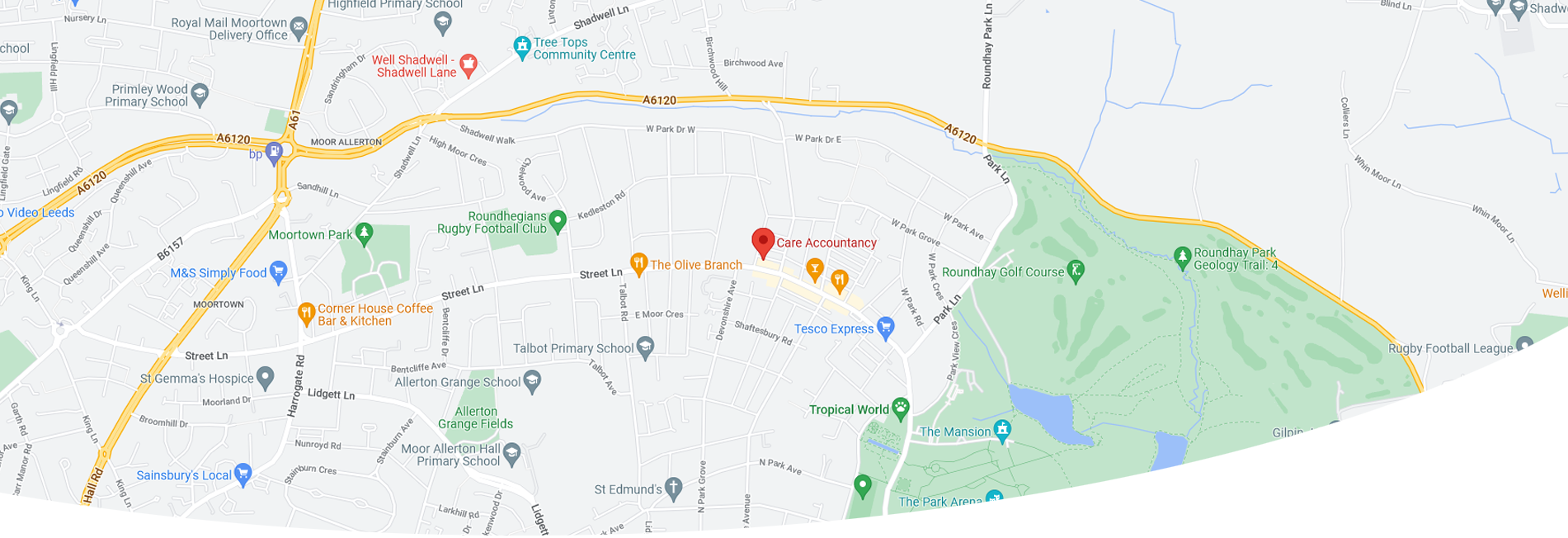
94 Street Lane
Rhoundhay
Leeds
LS8 2AL, UK
Address
9 Sheaf Lane
Coventry Road
Birmingham
B23 6EJ, UK
Contact
0113 8870 218
0121 7268 542
info@careaccountancy.co.uk
    Required fields are marked *

    https://careaccountancy.co.uk/wp-content/uploads/2022/03/leeds-map.png
    bt_bb_section_bottom_section_coverage_image
    CareAccountancyOffices
    Leeds: 94 Street Lane, Leeds
    Batley: 504B Bradford Road, WF17 5JY
    Bradford: 370A Otley Road, Bradford, BD2 4QR
    Birmingham: 9 Sheaf Lane, Coventry Road, Birmingham
    London: 180 King's Cross Rd, London, WC1X 9DE
    OUR LOCATIONSWhere to find us
    https://careaccountancy.co.uk/wp-content/uploads/2019/04/img-footer-map.png
    GET IN TOUCHCare Accountancy Social Links


    Copyright by CareAccountancy. All rights reserved.


    Copyright by CareAccountancy. All rights reserved.